Stakeholders and Growth Strategy
2025 will see the delivery of the Accra action-learning journey , the start of the Regenesis Story of Place programme, and potentially a few other exciting collaborations.
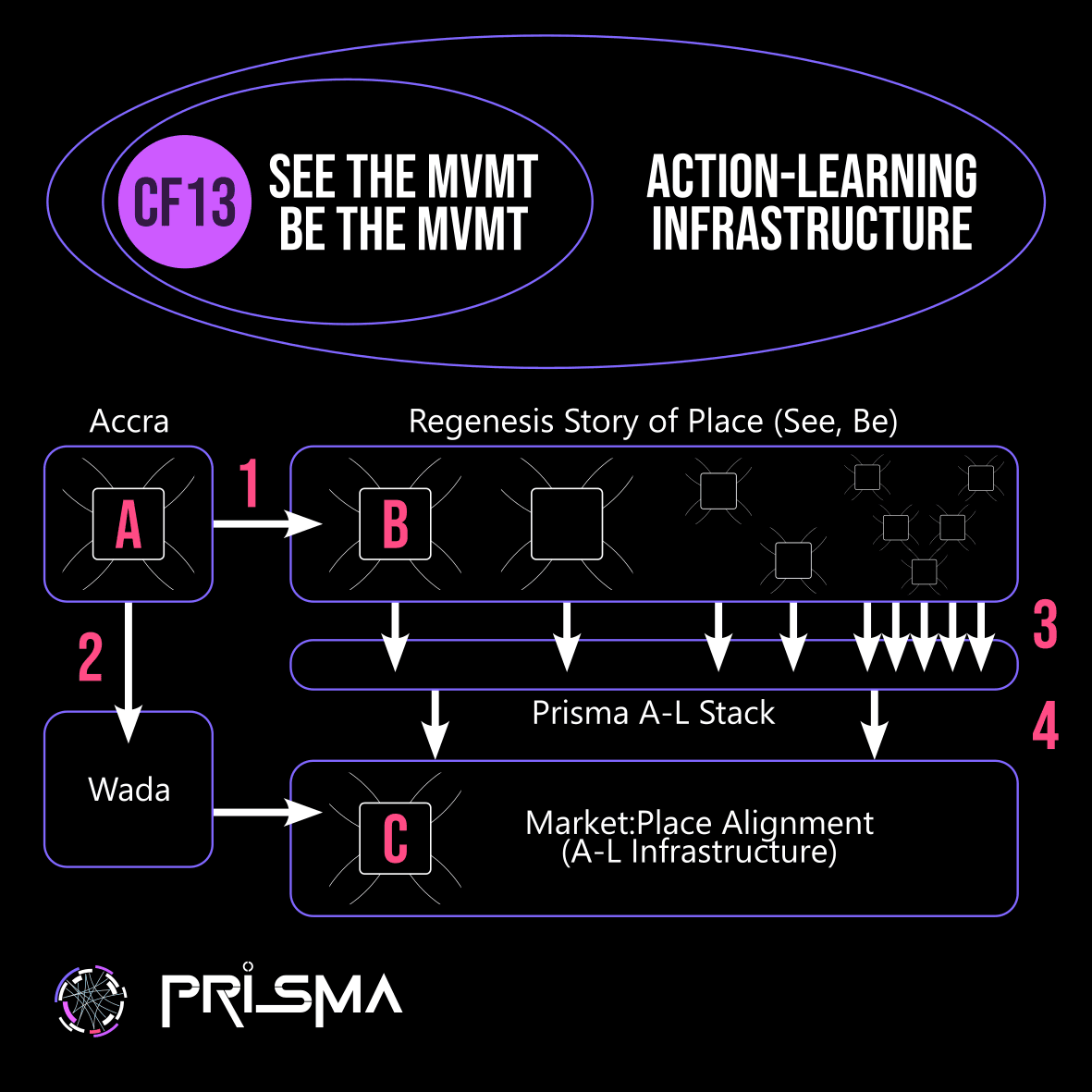
The image above shows the same underlying pattern of event organising, which applies four core processes, across three different contexts:
- A. Accra: Wada Hub in Accra, Ghana, for the Cardano Catalyst Fund 13 application
- B. Regenesis and aligned partners such as Resilience
- C. Regenerative Investing: atreyu & ria
In all the action-learning journeys (ALJs), we are aiming to form one or multiple action-learning teams that work on-the-ground on the development and application of an instrument (tooling).
Each ALJ also generates content: videos, interviews, call recordings, wikis, art works. This content is curated by the hubs to publish case-studies of the process.
These case studies are developmental learning accounts: each with levels of depth. Our [business model](business model) centres around the subscription to these journeys to access the depth. Each event is a catalyst for the ongoing storying of the work, ongoing action-learning, evolving thinking, making the subscription model appropriate. [Communities of place](Communities of place) own these learning accounts and are the primary recipients of subscription fees.
Over time, using these ALJs as the innovation engine, we will build out action-learning infrastructure: distributed means of participating in action-learning journeys. This is to work towards a platform where these events organise themselves and people work in a distributed manner on bioregional transition pathways. All capacities and resourcing is organised and accounted for in a decentralised manner by leveraging these underlying patterns we’re working on.
Roadmap
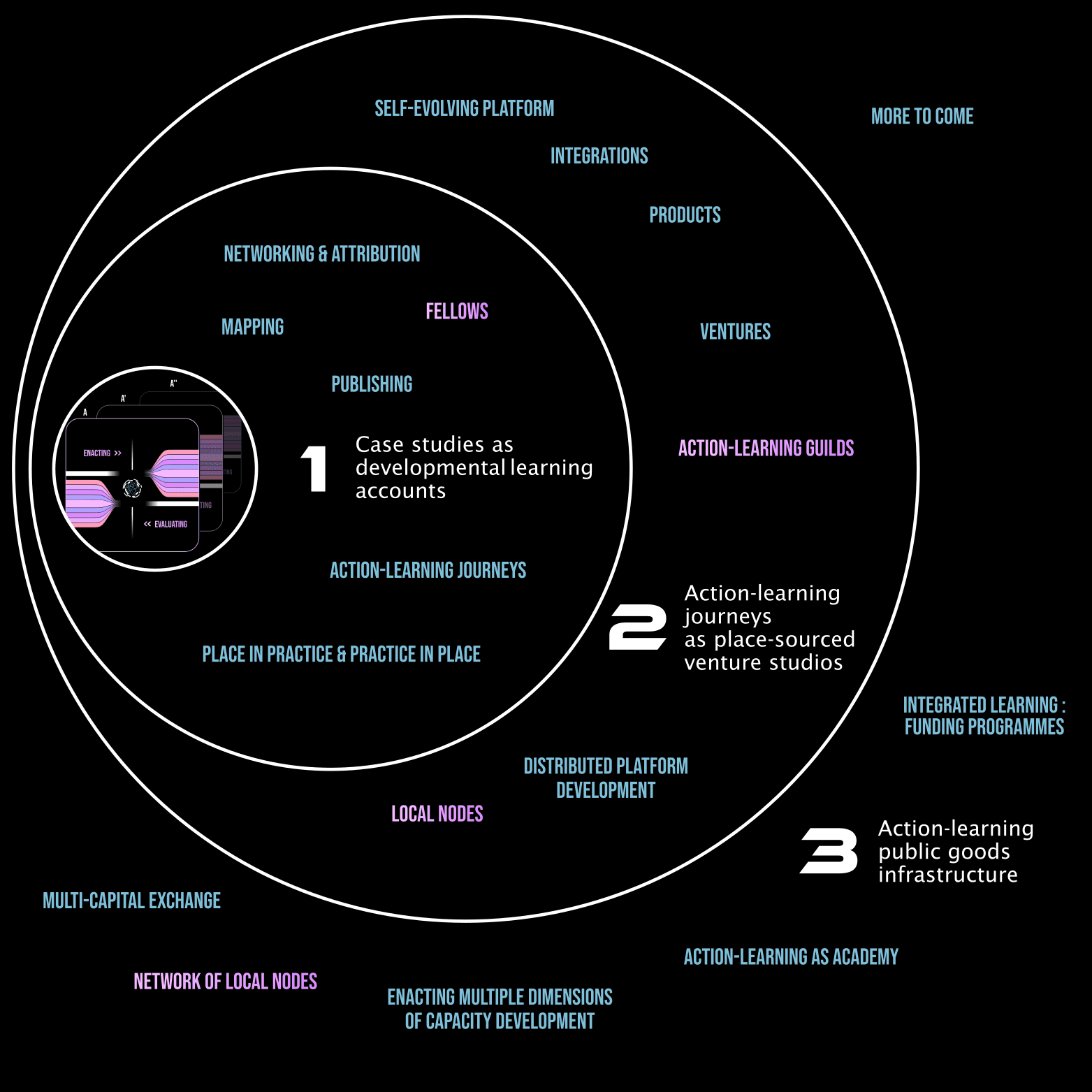
In summary, although each level is, to some extent, active simultaneously, we are focussing on the orders of system actualisation sequentially:
- Case studies: 2025+
- Incubation: 2026-2028+
- Self-organising ALJ Ecosystem: 2028-2030+
Case-studies as Developmental Accounts
In order to on-board hubs into self-organising and self-publishing capacity, prisma is first manually organising and facilitating several action-learning journeys (ALJs) to build internal capability for effective distributed system design.
This is also the period in which to generate clarity and cohesion of the core underlying patterns that are most relevant (see image) in publishing developmental accounts of action-learning:
- Mapping - making visible the network hub and the future ALJs being potentialised
- Publishing - making the learnings generated during the action-learning journey available to a broader audience
- action-learning journeys
- On-the-ground practitioners (aka fellows) - those who are stewarding the alignment between ALJ organising and place-sourced potential
- Practice-in-place and Place-in-practice - the challenge of working with such large systems as an evolving [community of practice](community of practice) and [communities of place](communities of place), and how they interrelate to co-evolve together, through hotspots of activity where transformation can occur. [^1]
- Networking - accounting for the practice-contributions that bring places to life (measurements of participation, system effects, and DAOs)
Therefore, by the end of this year, we are aiming to have generated the internal clarity of these patterns needed to be able to deliver on the promise of one published case-study per ALJ event. That means:
- Evaluation - how we make visible value
- Timeline interface making visible multiple layers of activity in an interactive front-end that becomes part of the case-study (in-progress)
- Thorough evaluation framework, aided by being able to explore the timeline, and in-formable by a given ALJ’s action design
- Enaction - how we activate self-organising
- Enaction design framework/ methodology
- Practice participation mechanisms
- Enaction-Evaluation interrelationship (action-learning)
- Potentialising - how we develop the potential of an [action-learning journey](action-learning journey)
- Mapping hub network and ALJ instances - the interface for where each case-study is published
- Enrolment - how we sign-up and on-board participants
- ALJ-specific stakeholder development pathways
- Sign-up forms
- On-boarding calls that facilitate alignment with enaction design
- ALJ-specific stakeholder development pathways
Scales-appropriate capabilities:
- Incubation outcome: product innovation
- Practice outcome: practice currency
- Organising team: prisma core
- Lead impulse: individual practitioner on-the-ground
- Prisma as distributed system:
- Evaluation interface complete
- Potentialising interface complete
Incubation
Scales-appropriate capabilities:
- Incubation outcome: organisation
- Practice outcome: practice DAO
- Organising team: hub team
- Lead impulse: hub and/ or practitioner-group
- Prisma as distributed system: all core processes with active DAO groups evolving them, rudimentary prisma on-chain governance and community currency systems
- Participant profiles
- Participation reputation
- Team-formation
- System-wide practice-currency visibility (seeing activity on-the-ground)
Self-organising ALJ Ecosystem
Scales-appropriate capabilities:
- Incubation outcome: ecosystemic partnerships shift
- Practice outcome: multiple practice DAO
- Organising team: hub team and partners
- Lead impulse: hub and/ or practitioner-group
- Prisma as distributed system: …