This Agreement (“Agreement”) is made and entered into as of 15.12.2025 by and between:
Aspecting OÜ, a company registered in Estonia, registry code 17374162, with registered address at Harju maakond, Tallinn, Kesklinna linnaosa, Tartu mnt 67/1-13b, 10115 (“Company”); and
Naoh Biel, an independent contractor, residing at Sant Boi, Barcelona (“Contractor” or “Project Manager”).
Collectively referred to as the “Parties.”
Context
This contract has been created to recognise the role of Project Manager (PM) for Prisma DIDs - a decentralised ID system used to register participants and generate contribution accounts.
The DIDs project, as an identity system for use in event organising and funding distribution, is a key enabling mechanism of making visible a given stakeholder’s actions and pathway through an action-learning journeys (ALJ/ ALJs).
Decentralised IDs function as a pre-accounting primitive: they provide the minimal identity substrate required to create, control, and attribute accounts in distributed systems without a central authority.
Purpose
The purpose of this first DIDs project is to design, develop, test and deploy a minimum viable identity system, for use in the next ALJ.
Contribution
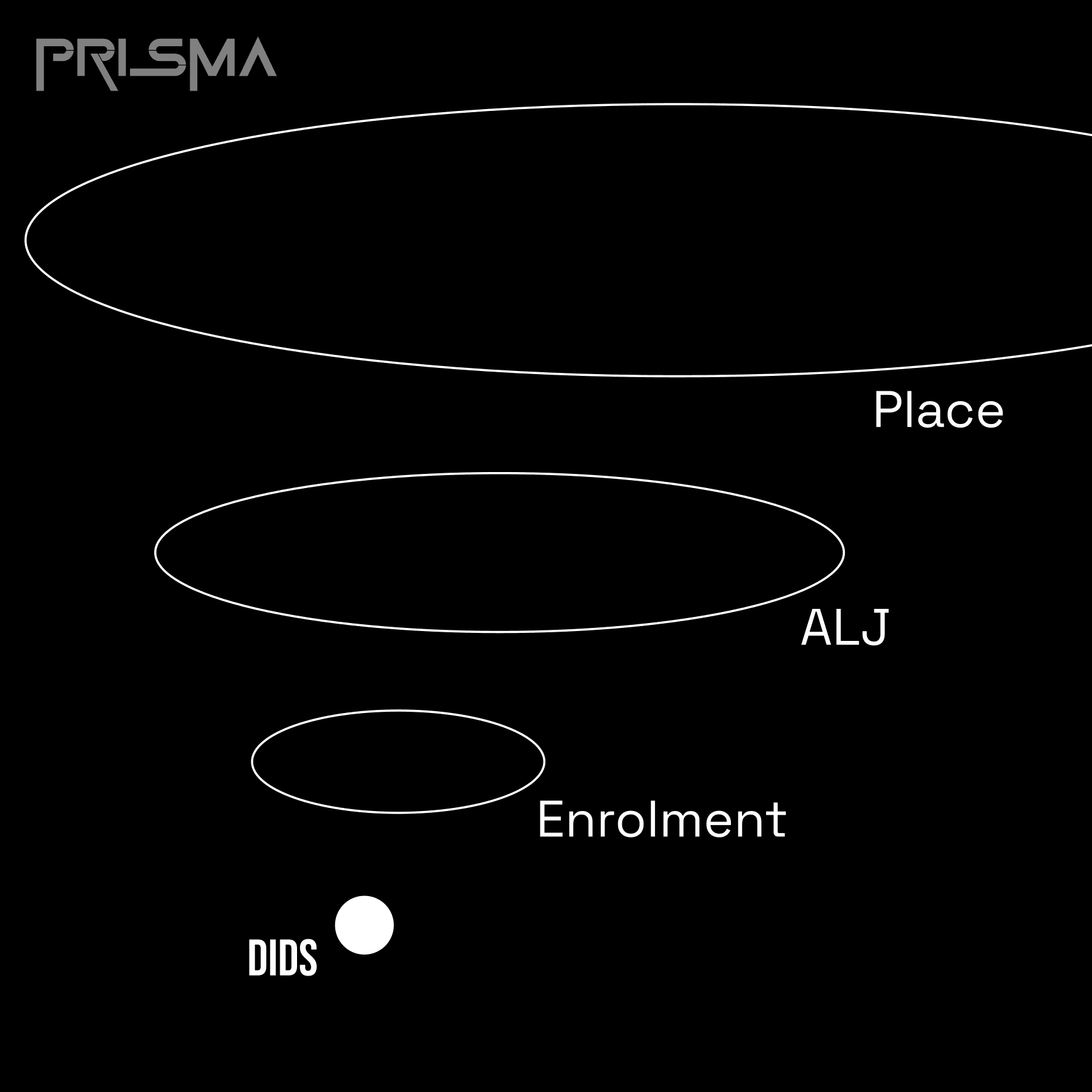
Stakeholders registration and onboarding is a key responsibility within the domain of enrolment. Therefore, DIDs is understood to be a mechanism with the registration app, used to issue identity records for use during the rest of the event. The DIDs project, therefore, is a part of and contributor to the overarching domain of enrolment process design.
Role: DIDs Project Manager
Description
The role of project manager is to ensure the successful delivery of the whole DIDs project with timeliness and ease. Where other roles fulfil requirements for specific production capacities, the project manager role is one of coordinating inter-operability between the rest of the roles with each other, as well as the project itself with the larger context of enrolment.
Domain and Responsibilities
Domain
The DIDs Project Manager must facilitate coordination across the whole of the DIDs project domain, ensuring the full scope of the project is covered, through organising with the rest of the team, as well as communicating any needs and/ or opportunities for the scope itself to be adapted. They are entrusted to facilitate decision-execution on action-points within the scope of the project, especially where prior alignment with its larger contexts has been ensured.
Responsibilities
Key responsibilities include…
- Enabling effective design work both within DIDs and in relation to its larger context of enrolment process design. Whilst the project manager role is not a design role, they must be able to support/ allow the creation of rigorous design practice. This requires…
- Cultivating, monitoring, and maintaining the relational and reflective conditions necessary for effective design. This includes the capacity to observe and reflect on one’s own behaviour and its impact on group dynamics; to recognise when enabling conditions for shared sense-making are present or absent; and to engage in timely, clear, and constructive communication to support collective observation of system dynamics.
- Sufficient emotional maturity and communicative capacity to enable open inquiry, feedback, and adaptive coordination, without avoidance, defensiveness, or suppression of relevant perspectives.
- Recognising that effective regenerative design depends on the ability of a group to jointly observe and interpret living system dynamics. The project manager is co-responsible for fostering the interpersonal, communicative, and reflective capacities that make such shared observation possible.
- Where a failure to engage in reflective communication or self-observation materially impairs collective sense-making or system understanding, such failure shall be considered a failure to perform the responsibilities of the role.
- Ensuring alignment of the DIDs project with the larger process design domain of enrolment and, subsequently, the organising and facilitation of ALJs as a whole (see image above).
- The overarching direction of DIDs development must derive from enabling the role of enrolment to contribute more effectively to the facilitation of an ALJ.
- The priorities of DIDs development must derive from the priorities of enrolment.
- The DIDs project and team members must be prepared to adapt to the needs and opportunities of enrolment, for any given ALJ.
- All functionality must be informed, as far as possible, by the needs and opportunities of enrolment, for any given ALJ.
- Regulation of project scope and timing such that it can be received by the larger context of enrolment in a balanced and equilibrated way.
- Enrolment design must be able to adapt to integrate the capabilities offered by the DIDs mechanism.
- Design and build requirements of DIDs must be informed by the capability enhancements able to be attained in enrolment process design.
- Communication of key updates, changes and risks.
- Changes within and around the DIDs project must be communicated to all relevant parties.
- The identification of relevant parties must be derived from the context surrounding the information at hand.
- Care must be taken to engage relevant parties in such a way that the information and its context is made accessible: “you’ve not heard the end of it until you’ve heard the heart of it.”
- Facilitating collaboration within and across the DIDs team, supporting the identification of roles, domains and responsibilities
- Forecasting and communicating effort and resources required, and any other dependencies, blockers, needs etc.
Out of Scope
- Performing hands-on software development, system architecture, or implementation work, except where explicitly agreed.
- Acting as the final decision-maker on strategic, governance, or budgetary matters beyond the scope of the DIDs project.
- Assuming responsibility for legal, regulatory, compliance, or data protection obligations.
- Acting as a substitute for enrolment facilitation, event organisation, or participant support roles.
- Guaranteeing project outcomes that are contingent on external dependencies, third-party systems, funding disbursements, or decisions made outside the DIDs project domain.
- Managing disputes, conflicts, or performance issues unrelated to the execution of the DIDs project.
Key Deliverables
The key deliverable of this project is to enable ALJ participants to be able to identify themselves within the context of an ALJ (including for access authorisation), sign key records (Verifiable Claims), and associate themselves to those records and other participants/ resources.
In addition to ensuring the successful delivery of the project outlined in the Prisma DIDs Catalyst Proposal , the project manager must:
- Organise: Define and adapt the roles through which the organisation of the DIDs team responds to the evolutions of the larger domain of enrolment.
- Integrate: By being in ongoing communication with larger system dynamics, the project manager is receiving a lot of feedback. They must continually integrate this information into how they are holding the development of the project as a whole, renewing their perspective/ frame of reference of both the project itself and its larger contexts (enrolment and ALJs - see image above).
- Publish: Reflect on and make visible, as learning content, the evolution of the project. This is to create an example of software development from a living systems perspective, which has both technical/ functional learnings as well as social/ organisational learnings.
- Evolve: Given the complexity and constant evolution of both the project and its larger contexts, the project manager must be prepared to be open to change. Therefore, the core understanding of the project concept, its role, and contribution to the larger domain of enrolment is expected to be clarified and deepened through the course of the project.
Term and Duration
- December 2025 - April 2026
Working Hours & Location
- Working hours flexible
- Meeting punctuality and reliability is required
- Remote work possible
- Effort must be made to connect in-person at least twice a month, either at a existing meeting premises or a suitable alternative. If an alternative is offered, the project manager must confirm a suitable venue.
Payments
Taxes & Status
- The Project Manager is engaged as an independent contractor and is not an employee, agent, partner, or representative of Aspecting OÜ. Nothing in this agreement creates an employment relationship.
- The Project Manager is solely responsible for all applicable taxes, social security contributions, and any other statutory obligations arising from the payments received under this agreement, including obligations under Estonian income tax, social tax, and mandatory insurance rules.
- Aspecting OÜ shall not withhold taxes, social security contributions, or other payments on behalf of the Project Manager, except to the extent required by Estonian law.
- The Project Manager is responsible for reporting and paying taxes on income received under this agreement in accordance with Estonian law, including filing any necessary declarations to the Estonian Tax and Customs Board.
- The Project Manager confirms that they have the right to provide services under Estonian law and, if applicable, holds any permits, registrations, or licenses required to operate as a self-employed contractor or private entrepreneur in Estonia.
Confidentiality & IP
Confidentiality
- The Project Manager agrees to treat as confidential all non-public information relating to Prisma, the DIDs project, enrolment processes, ALJs, collaborators, participants, and associated systems.
- Confidential information shall not be disclosed to any third party without prior written consent, except where required by law.
- These confidentiality obligations survive termination of this agreement.
Intellectual Property
- All work products, deliverables, materials, documentation, designs, specifications, and other outputs created by the Project Manager in connection with this agreement (“Work Product”) shall be the exclusive property of Aspecting OÜ.
- The Project Manager hereby irrevocably assigns to Aspecting OÜ all intellectual property rights, including copyright, in and to the Work Product, whether now known or created in the future, in all territories, without limitation. Aspecting OÜ shall have the exclusive right to use, reproduce, modify, distribute, license, or otherwise exploit the Work Product.
- To the extent permitted by law, the Project Manager waives any moral rights in the Work Product or consents to their use in a manner consistent with this agreement.
Termination
- Either party may terminate this agreement at any time with 14 days’ written notice.
- Prisma may terminate the agreement immediately in the event of:
- Material breach of responsibilities
- Failure to perform duties in a manner that materially impairs the project
- Breach of confidentiality or misuse of project assets
- Upon termination, the Project Manager shall be entitled only to payment for work corresponding to milestones successfully completed and approved prior to the termination date.
- No further compensation, damages, or penalties shall be payable upon termination.
Signatures
By signing below, the parties acknowledge that they have read, understood, and agreed to the terms of this contract.
For Prisma
Name:
Title:
Signature:
Date:
Project Manager
Name:
Signature:
Date: